AI tools
AI Autonomy: Automation and Delegation Explained
AI Autonomy: Automation and Delegation Explained
AI Autonomy: Automation and Delegation Explained

Christophe Roy
CEO & Co-founder
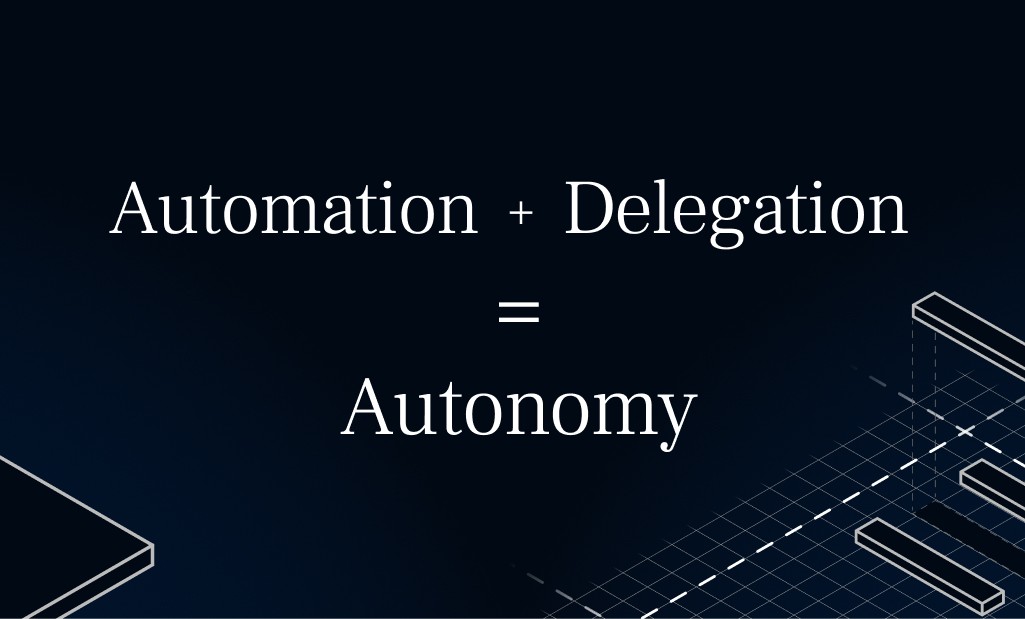
Autonomy is often described as the end goal of enterprise AI. Systems that “run themselves,” adapt to change, and operate at scale promise dramatic gains in speed, resilience, and efficiency. Yet many initiatives labeled autonomous fall short of that promise. The reason is simple: autonomy is frequently confused with automation.
Automation and autonomy are related, but they are not interchangeable. True AI autonomy depends on both automation and delegation—execution and decision-making working together. Without this distinction, organizations risk building faster systems that still require constant human intervention.
Automation: Executing What Is Known
Automation focuses on execution. It replaces human effort for tasks that follow predictable patterns and rules. In operational environments, automation typically handles actions such as validating inputs, synchronizing data between systems, triggering workflows, or applying predefined business logic.
The benefits are well understood. Automation reduces manual work, improves consistency, and enables scale. Tasks are completed faster and with fewer errors, freeing teams to focus on higher-value activities.
However, automation alone does not make a system autonomous. Automated systems still depend on humans to decide what should happen and when. When conditions change or unexpected scenarios arise, automation stops and escalates. The intelligence remains outside the system, embedded in human judgment and static rules.
As a result, heavily automated operations can still be fragile. They perform well under known conditions but struggle when variability increases.
Delegation: Deciding What Should Happen
Delegation addresses a different problem. It concerns decision-making authority.
When decision-making is delegated, a system is trusted not only to execute tasks, but also to interpret situations, choose actions, and adapt behavior based on outcomes. Instead of following scripts, the system operates against intent: goals, constraints, and priorities defined by humans.
Delegation enables systems to respond dynamically. Rather than escalating every exception, the system evaluates options, selects the most appropriate action, and learns from the result. This is where autonomy begins to emerge.
Importantly, delegation does not remove humans from the process. It changes their role. Humans remain responsible for defining objectives, setting boundaries, and overseeing outcomes. The system handles operational decisions at machine speed, while people focus on strategy, governance, and continuous improvement.
Why Autonomy Requires Both
Automation without delegation produces efficiency, but not autonomy. Delegation without automation produces intelligence, but not scale. Autonomous systems require both.
Automation provides the capacity to act reliably and repeatedly. Delegation provides the capacity to decide under uncertainty. Together, they allow systems to operate independently within defined limits.
This combination also explains why autonomy is difficult to achieve by simply adding more rules or more integrations. As complexity grows, rule-based automation becomes brittle. Each new scenario requires additional logic, increasing maintenance costs and cognitive load. Delegation, by contrast, allows systems to generalize and adapt without exhaustive specification.
Human and Machine Collaboration
A common misconception is that autonomous systems eliminate human involvement. In practice, the opposite is true. The most effective autonomous systems are collaborative.
Machines excel at speed, consistency, and pattern recognition. Humans excel at context, judgment, and defining what “good” looks like. Autonomy emerges when these strengths are combined thoughtfully.
In this model, humans are not removed from the loop; they operate at the right level of the loop. They guide intent, review performance, and intervene when objectives change. Systems execute and decide within those parameters, continuously refining their behavior.
Rethinking Autonomy
AI autonomy is not achieved by automating more tasks. It is achieved by delegating the right decisions, supported by robust automation.
Organizations that understand this distinction design systems differently. They focus less on scripting every step and more on defining clear goals, constraints, and feedback mechanisms. Over time, this enables systems that are not just faster, but more resilient and adaptive.
In short, autonomy is not about replacing people. It is about combining automation and delegation so that humans and machines each do what they do best—together.
Autonomy is often described as the end goal of enterprise AI. Systems that “run themselves,” adapt to change, and operate at scale promise dramatic gains in speed, resilience, and efficiency. Yet many initiatives labeled autonomous fall short of that promise. The reason is simple: autonomy is frequently confused with automation.
Automation and autonomy are related, but they are not interchangeable. True AI autonomy depends on both automation and delegation—execution and decision-making working together. Without this distinction, organizations risk building faster systems that still require constant human intervention.
Automation: Executing What Is Known
Automation focuses on execution. It replaces human effort for tasks that follow predictable patterns and rules. In operational environments, automation typically handles actions such as validating inputs, synchronizing data between systems, triggering workflows, or applying predefined business logic.
The benefits are well understood. Automation reduces manual work, improves consistency, and enables scale. Tasks are completed faster and with fewer errors, freeing teams to focus on higher-value activities.
However, automation alone does not make a system autonomous. Automated systems still depend on humans to decide what should happen and when. When conditions change or unexpected scenarios arise, automation stops and escalates. The intelligence remains outside the system, embedded in human judgment and static rules.
As a result, heavily automated operations can still be fragile. They perform well under known conditions but struggle when variability increases.
Delegation: Deciding What Should Happen
Delegation addresses a different problem. It concerns decision-making authority.
When decision-making is delegated, a system is trusted not only to execute tasks, but also to interpret situations, choose actions, and adapt behavior based on outcomes. Instead of following scripts, the system operates against intent: goals, constraints, and priorities defined by humans.
Delegation enables systems to respond dynamically. Rather than escalating every exception, the system evaluates options, selects the most appropriate action, and learns from the result. This is where autonomy begins to emerge.
Importantly, delegation does not remove humans from the process. It changes their role. Humans remain responsible for defining objectives, setting boundaries, and overseeing outcomes. The system handles operational decisions at machine speed, while people focus on strategy, governance, and continuous improvement.
Why Autonomy Requires Both
Automation without delegation produces efficiency, but not autonomy. Delegation without automation produces intelligence, but not scale. Autonomous systems require both.
Automation provides the capacity to act reliably and repeatedly. Delegation provides the capacity to decide under uncertainty. Together, they allow systems to operate independently within defined limits.
This combination also explains why autonomy is difficult to achieve by simply adding more rules or more integrations. As complexity grows, rule-based automation becomes brittle. Each new scenario requires additional logic, increasing maintenance costs and cognitive load. Delegation, by contrast, allows systems to generalize and adapt without exhaustive specification.
Human and Machine Collaboration
A common misconception is that autonomous systems eliminate human involvement. In practice, the opposite is true. The most effective autonomous systems are collaborative.
Machines excel at speed, consistency, and pattern recognition. Humans excel at context, judgment, and defining what “good” looks like. Autonomy emerges when these strengths are combined thoughtfully.
In this model, humans are not removed from the loop; they operate at the right level of the loop. They guide intent, review performance, and intervene when objectives change. Systems execute and decide within those parameters, continuously refining their behavior.
Rethinking Autonomy
AI autonomy is not achieved by automating more tasks. It is achieved by delegating the right decisions, supported by robust automation.
Organizations that understand this distinction design systems differently. They focus less on scripting every step and more on defining clear goals, constraints, and feedback mechanisms. Over time, this enables systems that are not just faster, but more resilient and adaptive.
In short, autonomy is not about replacing people. It is about combining automation and delegation so that humans and machines each do what they do best—together.
Autonomy is often described as the end goal of enterprise AI. Systems that “run themselves,” adapt to change, and operate at scale promise dramatic gains in speed, resilience, and efficiency. Yet many initiatives labeled autonomous fall short of that promise. The reason is simple: autonomy is frequently confused with automation.
Automation and autonomy are related, but they are not interchangeable. True AI autonomy depends on both automation and delegation—execution and decision-making working together. Without this distinction, organizations risk building faster systems that still require constant human intervention.
Automation: Executing What Is Known
Automation focuses on execution. It replaces human effort for tasks that follow predictable patterns and rules. In operational environments, automation typically handles actions such as validating inputs, synchronizing data between systems, triggering workflows, or applying predefined business logic.
The benefits are well understood. Automation reduces manual work, improves consistency, and enables scale. Tasks are completed faster and with fewer errors, freeing teams to focus on higher-value activities.
However, automation alone does not make a system autonomous. Automated systems still depend on humans to decide what should happen and when. When conditions change or unexpected scenarios arise, automation stops and escalates. The intelligence remains outside the system, embedded in human judgment and static rules.
As a result, heavily automated operations can still be fragile. They perform well under known conditions but struggle when variability increases.
Delegation: Deciding What Should Happen
Delegation addresses a different problem. It concerns decision-making authority.
When decision-making is delegated, a system is trusted not only to execute tasks, but also to interpret situations, choose actions, and adapt behavior based on outcomes. Instead of following scripts, the system operates against intent: goals, constraints, and priorities defined by humans.
Delegation enables systems to respond dynamically. Rather than escalating every exception, the system evaluates options, selects the most appropriate action, and learns from the result. This is where autonomy begins to emerge.
Importantly, delegation does not remove humans from the process. It changes their role. Humans remain responsible for defining objectives, setting boundaries, and overseeing outcomes. The system handles operational decisions at machine speed, while people focus on strategy, governance, and continuous improvement.
Why Autonomy Requires Both
Automation without delegation produces efficiency, but not autonomy. Delegation without automation produces intelligence, but not scale. Autonomous systems require both.
Automation provides the capacity to act reliably and repeatedly. Delegation provides the capacity to decide under uncertainty. Together, they allow systems to operate independently within defined limits.
This combination also explains why autonomy is difficult to achieve by simply adding more rules or more integrations. As complexity grows, rule-based automation becomes brittle. Each new scenario requires additional logic, increasing maintenance costs and cognitive load. Delegation, by contrast, allows systems to generalize and adapt without exhaustive specification.
Human and Machine Collaboration
A common misconception is that autonomous systems eliminate human involvement. In practice, the opposite is true. The most effective autonomous systems are collaborative.
Machines excel at speed, consistency, and pattern recognition. Humans excel at context, judgment, and defining what “good” looks like. Autonomy emerges when these strengths are combined thoughtfully.
In this model, humans are not removed from the loop; they operate at the right level of the loop. They guide intent, review performance, and intervene when objectives change. Systems execute and decide within those parameters, continuously refining their behavior.
Rethinking Autonomy
AI autonomy is not achieved by automating more tasks. It is achieved by delegating the right decisions, supported by robust automation.
Organizations that understand this distinction design systems differently. They focus less on scripting every step and more on defining clear goals, constraints, and feedback mechanisms. Over time, this enables systems that are not just faster, but more resilient and adaptive.
In short, autonomy is not about replacing people. It is about combining automation and delegation so that humans and machines each do what they do best—together.

" width="23.85253667522511px"><path d="M 21.134 0 L 19.972 2.046 L 11.658 2.046 C 11.169 2.046 10.772 2.443 10.772 2.932 L 10.772 24 L 8.726 22.838 L 8.726 2.932 C 8.726 2.443 8.329 2.046 7.84 2.046 L 0 2.046 L 1.162 0 Z M 19.973 3.887 L 21.064 5.796 L 15.408 5.796 C 14.919 5.796 14.522 6.193 14.522 6.682 L 14.522 22.844 L 12.613 23.981 L 12.613 3.887 Z M 6.885 3.887 L 6.885 5.864 L 1.222 5.864 L 0.026 3.887 Z M 23.853 2.94 L 22.696 4.928 L 21.488 2.93 L 22.644 0.988 Z" fill="rgb(0, 0, 0)" height="24px" id="IhpQBSBxF" stroke-dasharray="" stroke-linecap="butt" stroke-linejoin="miter" stroke-miterlimit="10" stroke-width="0.95" stroke="rgb(0, 0, 0)" width="23.85253667522511px"/></g></svg>)


Trame. All right reserved. © 2026
Resources
Trame. All right reserved. © 2026
Resources
Trame. All right reserved. © 2026