AI tools
The Next Evolution of Supply Chains: From Automation to Autonomy
The Next Evolution of Supply Chains: From Automation to Autonomy
The Next Evolution of Supply Chains: From Automation to Autonomy

Christophe Roy
CEO & Co-founder
Industry 4.0 laid the foundations: process digitization, system interconnection, large-scale data collection, and local automation. It enabled optimization and standardization, but it is now outdated without ever having been fully completed.
Today, supply chains must be fast, agile, and sustainable. Autonomy, now made possible by recent advances in AI, is the new strategy for creating unprecedented value and resilience. Companies that cling to outdated models will struggle to remain relevant.
Why achieve autonomy in the supply chain ?
According to a study conducted by Accenture among 1,000 C-suite executives, autonomous supply chains are expected to deliver measurable gains, both financial and operational.
On average, surveyed companies anticipate a 5% increase in EBITDA and a 7% improvement in return on capital employed (ROCE). Operationally, respondents project a 27% reduction in order processing times, a 25% increase in labor productivity, and a 5% improvement in on time delivery rates. These gains would enable organizations to better absorb uncertainty and disruptions, with reaction time and recovery time reduced by 62% and 60% respectively.
What is the autonomy index in supply chain ?
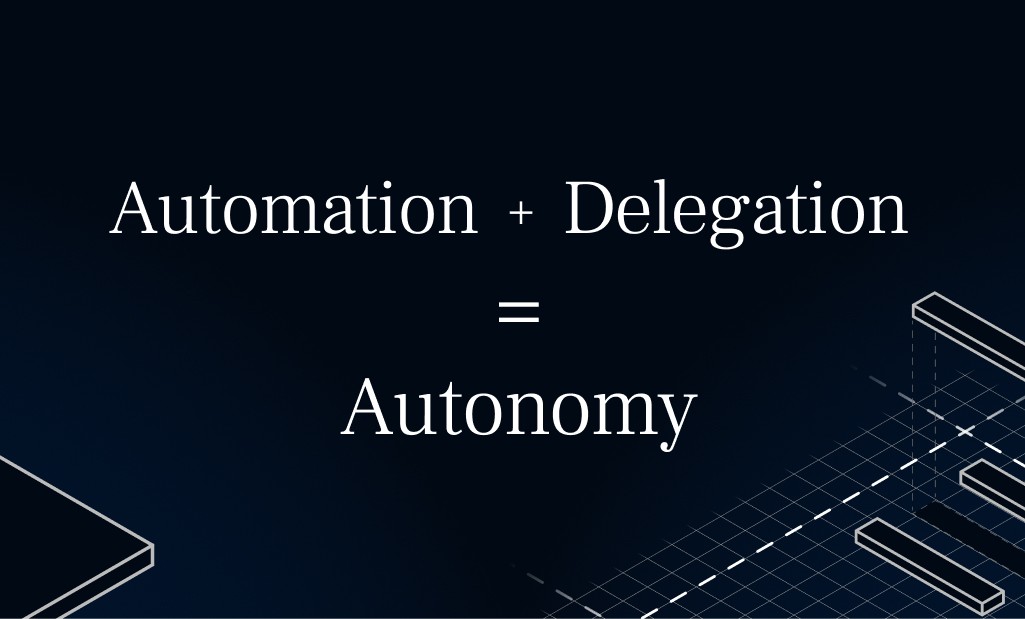
The autonomy index represents the operational capabilities of supply chains based on the use of AI, designed for automation and delegation, the two components required for autonomy.
What is automation in supply chain ?
Automation executes repetitive tasks according to predefined rules. Think of a car’s cruise control: it maintains a set speed, but still requires human intervention for steering, braking, and handling unexpected situations.
What is delegation in supply chain ?
Delegation builds on automation but goes further by allowing the system to make operational decisions on its own. It is comparable to an autonomous vehicle, capable of analyzing its environment, acting accordingly, and operating with little or no human intervention.
Why AI in the supply chain?
The nature of supply chains, which is process- and data-driven, makes them an ideal use case for technologies such as AI.
Platforms specializing in AI-based process automation for enterprise operations, such as Trame, can orchestrate complex decision-making faster and more efficiently than before.
Certain activities, such as Procurement: The First Autonomous Use Case, are particularly well suited to automation, and even full autonomy, due to their repetitive and predictable tasks.
Industry 4.0 laid the foundations: process digitization, system interconnection, large-scale data collection, and local automation. It enabled optimization and standardization, but it is now outdated without ever having been fully completed.
Today, supply chains must be fast, agile, and sustainable. Autonomy, now made possible by recent advances in AI, is the new strategy for creating unprecedented value and resilience. Companies that cling to outdated models will struggle to remain relevant.
Why achieve autonomy in the supply chain ?
According to a study conducted by Accenture among 1,000 C-suite executives, autonomous supply chains are expected to deliver measurable gains, both financial and operational.
On average, surveyed companies anticipate a 5% increase in EBITDA and a 7% improvement in return on capital employed (ROCE). Operationally, respondents project a 27% reduction in order processing times, a 25% increase in labor productivity, and a 5% improvement in on time delivery rates. These gains would enable organizations to better absorb uncertainty and disruptions, with reaction time and recovery time reduced by 62% and 60% respectively.
What is the autonomy index in supply chain ?
The autonomy index represents the operational capabilities of supply chains based on the use of AI, designed for automation and delegation, the two components required for autonomy.
What is automation in supply chain ?
Automation executes repetitive tasks according to predefined rules. Think of a car’s cruise control: it maintains a set speed, but still requires human intervention for steering, braking, and handling unexpected situations.
What is delegation in supply chain ?
Delegation builds on automation but goes further by allowing the system to make operational decisions on its own. It is comparable to an autonomous vehicle, capable of analyzing its environment, acting accordingly, and operating with little or no human intervention.
Why AI in the supply chain?
The nature of supply chains, which is process- and data-driven, makes them an ideal use case for technologies such as AI.
Platforms specializing in AI-based process automation for enterprise operations, such as Trame, can orchestrate complex decision-making faster and more efficiently than before.
Certain activities, such as Procurement: The First Autonomous Use Case, are particularly well suited to automation, and even full autonomy, due to their repetitive and predictable tasks.
Industry 4.0 laid the foundations: process digitization, system interconnection, large-scale data collection, and local automation. It enabled optimization and standardization, but it is now outdated without ever having been fully completed.
Today, supply chains must be fast, agile, and sustainable. Autonomy, now made possible by recent advances in AI, is the new strategy for creating unprecedented value and resilience. Companies that cling to outdated models will struggle to remain relevant.
Why achieve autonomy in the supply chain ?
According to a study conducted by Accenture among 1,000 C-suite executives, autonomous supply chains are expected to deliver measurable gains, both financial and operational.
On average, surveyed companies anticipate a 5% increase in EBITDA and a 7% improvement in return on capital employed (ROCE). Operationally, respondents project a 27% reduction in order processing times, a 25% increase in labor productivity, and a 5% improvement in on time delivery rates. These gains would enable organizations to better absorb uncertainty and disruptions, with reaction time and recovery time reduced by 62% and 60% respectively.
What is the autonomy index in supply chain ?
The autonomy index represents the operational capabilities of supply chains based on the use of AI, designed for automation and delegation, the two components required for autonomy.
What is automation in supply chain ?
Automation executes repetitive tasks according to predefined rules. Think of a car’s cruise control: it maintains a set speed, but still requires human intervention for steering, braking, and handling unexpected situations.
What is delegation in supply chain ?
Delegation builds on automation but goes further by allowing the system to make operational decisions on its own. It is comparable to an autonomous vehicle, capable of analyzing its environment, acting accordingly, and operating with little or no human intervention.
Why AI in the supply chain?
The nature of supply chains, which is process- and data-driven, makes them an ideal use case for technologies such as AI.
Platforms specializing in AI-based process automation for enterprise operations, such as Trame, can orchestrate complex decision-making faster and more efficiently than before.
Certain activities, such as Procurement: The First Autonomous Use Case, are particularly well suited to automation, and even full autonomy, due to their repetitive and predictable tasks.
" width="23.85253667522511px"><path d="M 21.134 0 L 19.972 2.046 L 11.658 2.046 C 11.169 2.046 10.772 2.443 10.772 2.932 L 10.772 24 L 8.726 22.838 L 8.726 2.932 C 8.726 2.443 8.329 2.046 7.84 2.046 L 0 2.046 L 1.162 0 Z M 19.973 3.887 L 21.064 5.796 L 15.408 5.796 C 14.919 5.796 14.522 6.193 14.522 6.682 L 14.522 22.844 L 12.613 23.981 L 12.613 3.887 Z M 6.885 3.887 L 6.885 5.864 L 1.222 5.864 L 0.026 3.887 Z M 23.853 2.94 L 22.696 4.928 L 21.488 2.93 L 22.644 0.988 Z" fill="rgb(0, 0, 0)" height="24px" id="IhpQBSBxF" stroke-dasharray="" stroke-linecap="butt" stroke-linejoin="miter" stroke-miterlimit="10" stroke-width="0.95" stroke="rgb(0, 0, 0)" width="23.85253667522511px"/></g></svg>)


Trame. All right reserved. © 2026
Resources
Trame. All right reserved. © 2026
Resources
Trame. All right reserved. © 2026